Why people give up on food tracking
Every tracking app has the same drop-off curve. I call it the disengagement gap: the moment the novelty wears off and logging starts to feel like homework. For people who eat home-cooked Indian food, it comes even sooner, because the apps were never built for a thali.
Logs every meal, weighs the rice, checks macros twice a day.
Searching for "aloo gobi" returns five entries with five calorie counts.
Manual entry fatigueA work trip, a cold, a wedding. The plan doesn't know.
Rigid planThe streak breaks. The app shows a red number and nothing else.
No empathyThe app stops being opened. It never asks why.
Who it's for: people starting over (again)
- Context
- Tech job in the Bay Area. Cooks Indian food at home, travels twice a month.
- History
- Tried MyFitnessPal and HealthifyMe. Quit each within a month.
By the time I find the right dal entry, I've lost the will to log dinner.
- Context
- Lives in Pune. His doctor told him to lose 8 kg. Eats what his family cooks.
- Needs
- Guidance that fits a family kitchen, not a bodybuilder's meal prep.
I can't weigh my food. Just tell me what to eat tomorrow.
- Context
- Consultant with weeks on the road and weeks at home. Gets sick a few times a year.
- Needs
- A plan she can pause without starting over.
Every time I travel, I lose my streak and my motivation.
Personas are illustrative.
How MyFitnessPal, HealthifyMe and Fittr compare
I analysed the three most-used tracking apps among my target users on two things: how logging feels, and how each one keeps people accountable. Analysis as of late 2025
| App | How you log | Effort | Speed | Accuracy | Accountability model |
|---|---|---|---|---|---|
| MyFitnessPalThe database | Search and barcode scan. Great for packaged food; you guess portions for everything else. | Moderate | Fast | Medium Crowdsourced entries | Self-accountability. Reminders and streaks. If you stop, it doesn't notice. |
| HealthifyMeThe AI snap | Photo, text and voice. Handles multi-dish thalis well. | Lowest | Fastest | Medium Misses hidden ghee and oil | AI nudges. A coach that pings you, plus glucose monitors on the premium tier. Easy to snooze. |
| FittrMacro precision | Manual search of raw ingredients, weighed in grams. | Highest | Slowest | Highest Verified entries | Human coaches and peers. Hardest to ignore, but only as good as your coach, and intimidating for beginners. |
| Ridge HealthThe adaptive coach | Voice first, plus one-tap confirm of meals already in your plan. | Low | Fast | Medium Plan-anchored portions | Empathetic adaptation. Rest days, treat days, pause, and targets that adjust to how your week actually went. |
Where every app falls short
Can't tell a lazy day from a mental-health day, a fever or a trip.
Plans ignore what actually happened last week.
Accountability ends at goal weight, so the weight comes back.
You can log a salad while eating a pizza.
Where Ridge sits
Ridge's SWOT
SStrengths
- Lowest-effort logging: voice, plus one-tap confirm of meals already in the plan.
- Built for Indian kitchens: daliya, roti with dal and sabzi, tofu with brown rice, with India and US regions.
- Empathy as a feature: rest days, treat periods and Pause My Plan are core, not add-ons.
- Adaptive targets that respond to how the last week actually went.
WWeaknesses
- AI reliability: in testing, meal ideas failed when both AI providers were down at once.
- Accuracy ceiling: voice estimates miss hidden oil and ghee, the same issue photo logging has.
- No human layer yet: Coach and Community are still "coming soon."
- Solo-built MVP with no proven retention data yet.
OOpportunities
- The empathy gap is wide open. No major player adapts to sick days, travel or festivals.
- Indian diaspora in the US: Western databases serve them badly and Indian apps are built for India.
- Hybrid AI plus human coaching as a premium tier, combining Fittr's stickiness with AI's scale.
- Maintenance mode for life after the goal, which every competitor drops.
TThreats
- HealthifyMe already has voice and photo AI and can copy empathy features.
- MyFitnessPal's database is a moat for packaged food.
- Notification fatigue: AI nudges get snoozed, and Ridge isn't immune.
- LLM cost per user and health-advice regulation as the product scales.
I'd rather people log roughly every day than perfectly for one week.
Optimise for consistency over precision. Make logging nearly effortless, and make a bad day cost nothing. If people keep showing up, accuracy can improve over time. If they quit, nothing else matters.
Walking through the app
 1
2
3
4
5
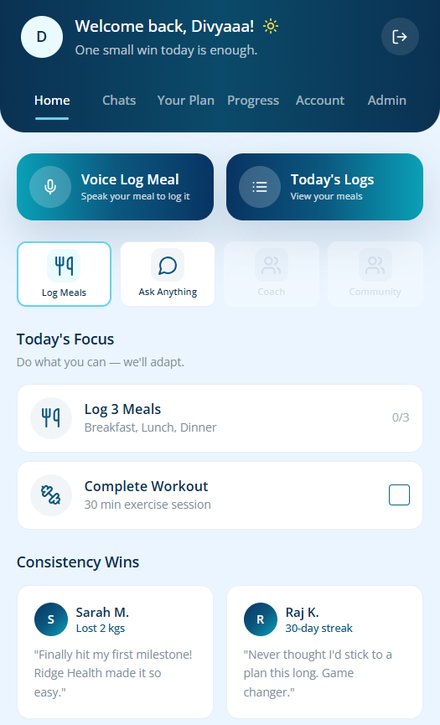
"One small win today is enough." The greeting sets expectations before the user sees a single number.
"Voice Log Meal" is the biggest button on the screen. Say "two rotis and a bowl of dal" and it's logged.
Coach and Community are visible but greyed out. They signal the roadmap without crowding the MVP.
"Today's Focus" asks for three meals and one workout, with the promise "Do what you can, we'll adapt."
"Consistency Wins" celebrates streaks and small milestones, not dramatic before-and-afters that intimidate beginners.
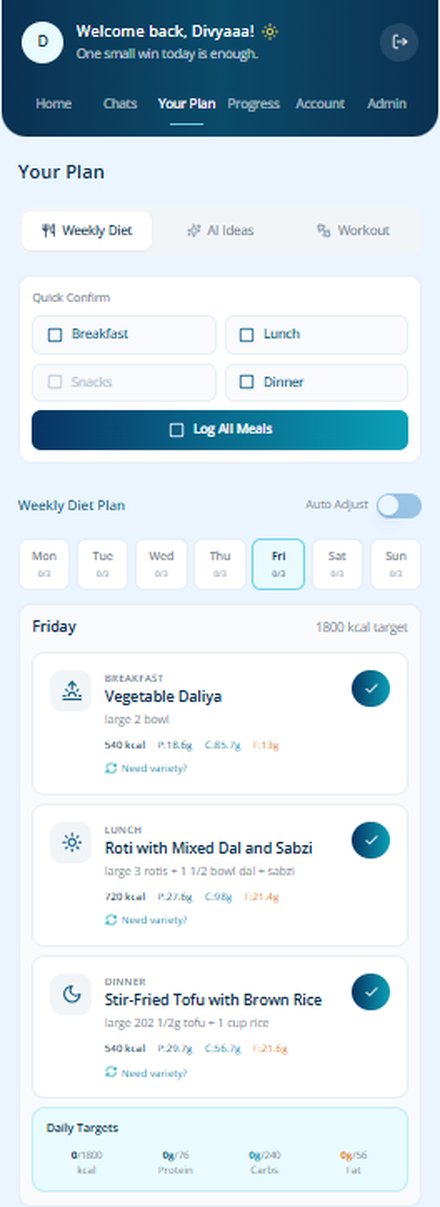
Vegetable daliya for breakfast. Three rotis with dal and sabzi for lunch. Portions in bowls and rotis, not grams, with macros shown underneath.
If you ate what the plan said, tick Breakfast, Lunch and Dinner, or hit "Log All Meals." Logging a planned day takes about three seconds.
Every meal has a one-tap swap, so boredom doesn't become a reason to quit.
Turn it on and next week's targets learn from this week. More on that below.
 6
7
9
Designed for real life, not perfect weeks
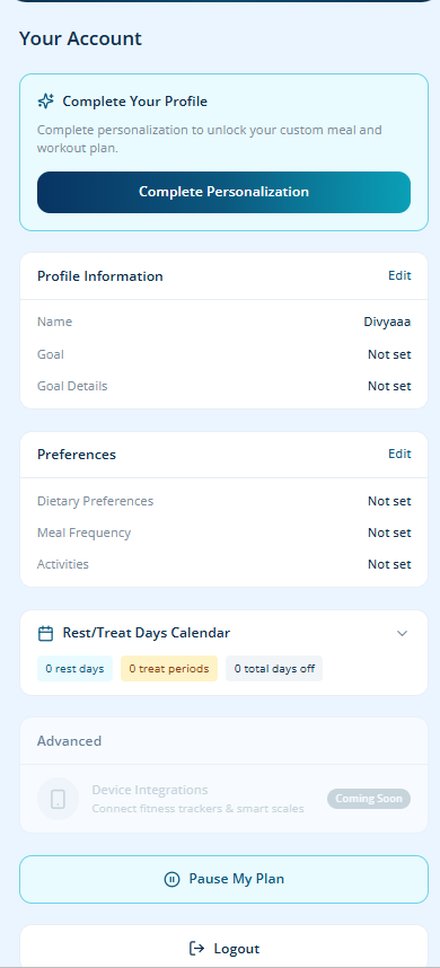
Mark a Diwali weekend, a birthday or a recovery day in advance. They count as planned days off, so the streak survives.
Sick, travelling or simply overwhelmed? Pause instead of quitting. Coming back is one tap, with no restart and no lost history.
Goal, dietary preferences, meal frequency and activities shape the plan. The prompt explains what you get for filling them in.
Progress that encourages instead of judging
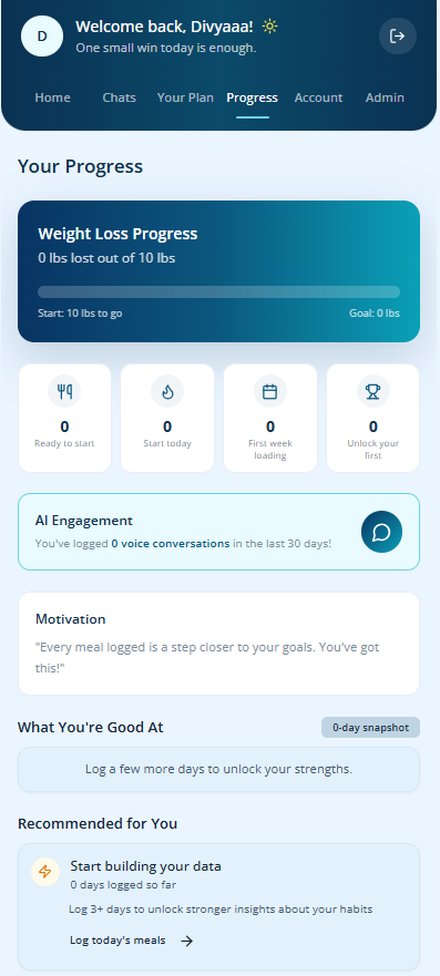
A strengths-based snapshot that unlocks after a few days of logging. It leads with what's working, not what's missing.
Day one shows "Ready to start" and "First week loading," never a wall of zeros labelled as failure.
Voice conversations are counted and shown, which is how I track whether the voice-first bet is working.
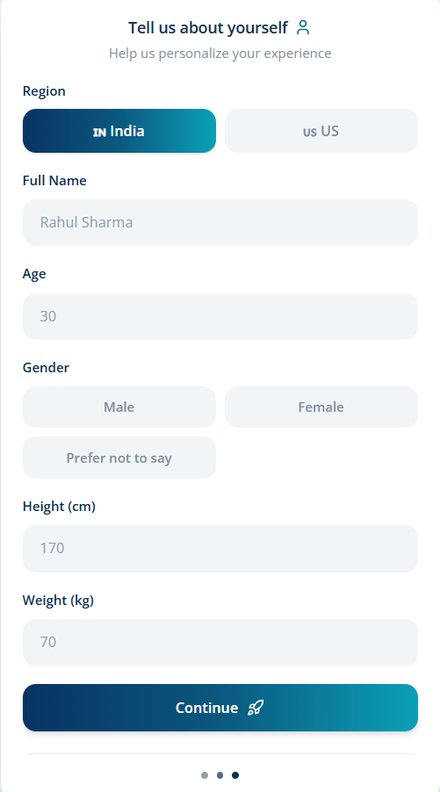
Onboarding in under a minute
India or US decides the food library, units and meal suggestions from the very first screen.
Age, gender, height and weight are enough to set a starting calorie target. Everything else can wait until the user sees value.
The three AI features
Auto Adjust: the plan learns from your week

Last week's target (12,600 kcal) against what was actually logged (3,600 kcal).
"Last week was 71% under target" sits right above the change, so the user knows why.
Original, adjusted and change, day by day. No black-box changes to someone's diet.
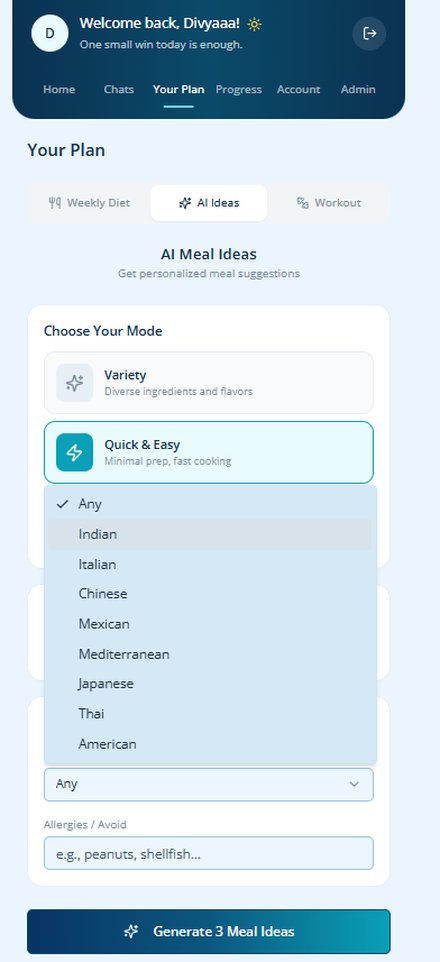
AI Meal Ideas: never stuck on "what do I eat?"
- Two modes match real moods: Variety for new flavours, Quick & Easy for minimal prep after a long day.
- Nine cuisines, Indian first in the list, so suggestions fit what's in the fridge.
- Allergies and avoid list sent with every request, so the model never suggests peanuts to someone allergic.
- Three ideas, not thirty. Fewer choices means a faster decision.
Voice logging and Ask Anything
- Natural speech becomes structured meals with portions and macros.
- "Ask Anything" is a chat coach for questions like "Is poha okay before a workout?", with guardrails that keep it to wellness, not medical advice.
Built for failure
Requests go to Gemini 1.5 Flash first, with GPT-4o-mini as the fallback. Testing surfaced a case where both failed at once. The fix on my list is a third layer: a curated library of pre-written meal ideas, so the user always gets an answer.
Why I went voice-first, and what made it hard
Why I built voice first
- Effort is why people quit. My competitive research showed manual entry fatigue as the top reason people drop MyFitnessPal and Fittr. Speaking a meal takes seconds.
- Indian meals don't fit search boxes. "Do roti, ek katori dal aur thodi sabzi" is one sentence out loud, and six searches in a database.
- Hands are busy. People log while cooking, eating or walking. One tap to speak beats typing on a phone.
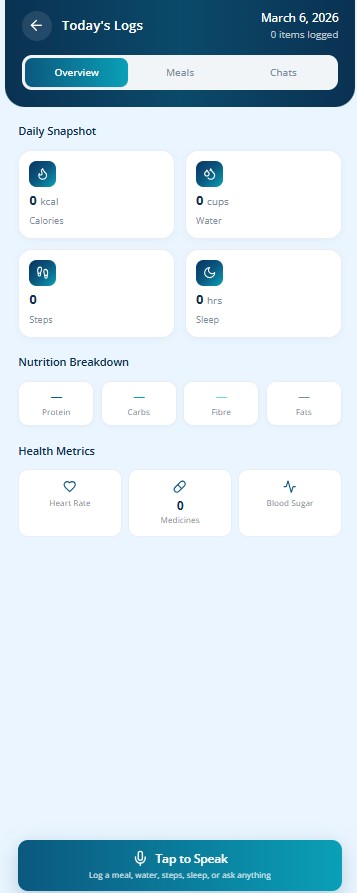
- One input for everything. The same "Tap to Speak" button logs a meal, water, steps or sleep, or asks a question.
How it works
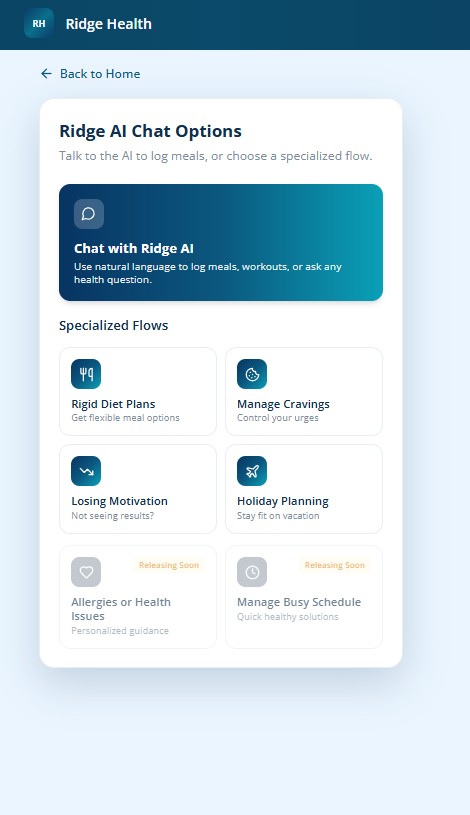
Questions go to Chat with Ridge AI, which has specialised flows for the moments people usually give up: rigid diet plans, cravings, losing motivation and holiday planning. Allergies and busy-schedule flows are next.
Challenges I hit
| Challenge | Example |
|---|---|
| Mixed-language speech | "Ek plate poha with chai" |
| Vague portions | "Thoda sa rice," "dedh katori dal" |
| Several things in one sentence | "Had lunch, drank 2 glasses of water, walked 20 minutes" |
| Being misunderstood | "Didn't understand" was the top thumbs-down reason in my feedback data |
| Latency | Voice feels broken if the reply takes more than about 3 seconds |
"Didn't understand" being the top thumbs-down reason is why a Hinglish evaluation set is first on my list.
How I evaluate the AI
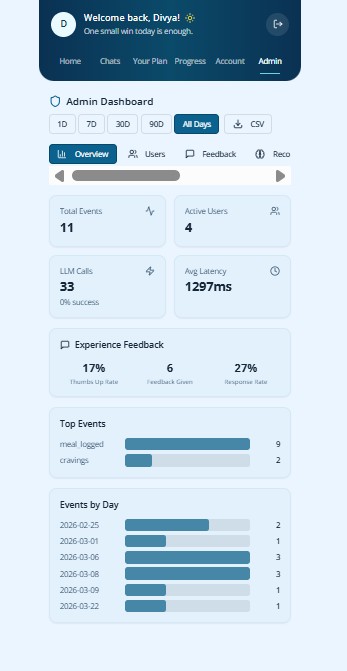
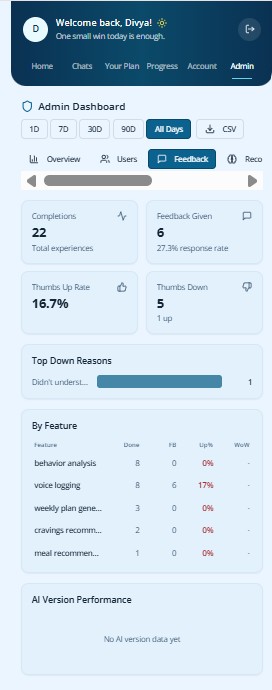
Ridge has a built-in admin console that tracks every AI feature on three layers: what users think of it, how the models behave, and whether the service meets its targets. With only a handful of beta users, it already caught the most important problem in the product.
Thumbs up or down on every AI experience, a reason when it's down, and results broken out by feature.
- 22 completed AI experiences
- 6 ratings, a 27.3% response rate
- Voice logging: 8 uses, 6 ratings, 17% positive
- Top complaint: "Didn't understand"
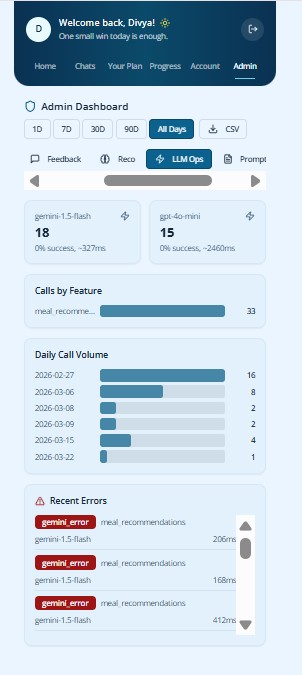
Every call is logged with feature, provider, latency and errors, so the two models can be compared side by side.
- Gemini 1.5 Flash: 18 calls, ~327 ms
- GPT-4o-mini fallback: 15 calls, ~2,460 ms
- Daily call volume and recent errors
- Prompt versions tracked separately
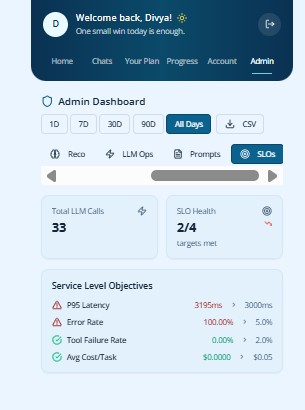
Four service-level objectives with explicit targets, checked against live data.
- p95 latency under 3,000 ms
- Error rate under 5%
- Tool failure rate under 2%
- Cost per task under $0.05
SLO scorecard
| Objective | Target | Actual | Status |
|---|---|---|---|
| p95 latency | < 3,000 ms | 3,195 ms | Missed |
| Error rate | < 5% | 100% | Missed |
| Tool failure rate | < 2% | 0% | Met |
| Average cost per task | < $0.05 | $0.0000 | Met |
What the data told me, and what I did
All 33 traced calls errored on both Gemini and GPT-4o-mini. The fallback switched providers, but the request itself failed in both places.
ActionDebug the request itself, since both providers failed on the same input, and add a curated fallback so people always get ideas.
$0.0000 per task looked great, but only because failed calls cost nothing.
ActionAn SLO only counts when its dependencies pass. Cost per successful task is the real metric.
GPT-4o-mini averaged ~2,460 ms against ~327 ms for Gemini Flash, which pushed p95 past the 3-second target.
ActionKeep the fast model on the voice path, use the slower one only off the critical path, and add a timeout before falling back.
8 uses, 17% positive, and "Didn't understand" as the top reason.
ActionBuild a Hinglish meal-phrase eval set and score parsing accuracy on every prompt change.
Every traced call came from meal recommendations, while voice logging and behaviour analysis showed usage but no traces.
ActionInstrument every AI feature the same way before adding new ones.
Closed beta with 4 active users, so the numbers point to problems rather than prove trends. The point was to build the measurement loop before growth, not after.
The evaluation loop
Next: an offline eval set of real meal phrases scored before every release, and LLM-as-judge scoring for meal-idea quality, so I can catch regressions before users do. The console already has an "AI version performance" view waiting for that data.
What Priya gets out of it
Voice or one-tap confirm replaces searching a database and guessing portions.
Daliya, dal and roti are in the plan, with portions in bowls and rotis.
Pause, rest days and treat days keep her in the habit through travel and illness.
Three meal ideas on demand, matched to mood, cuisine and allergies.
Progress leads with strengths and small streaks instead of red numbers.
Every plan adjustment shows what changed and why.
What I'm measuring
Targets for a 90-day beta, not results yet.
It directly measures closing the disengagement gap.
- Target 35% of signups
- Median time to log a meal < 10s
- Meals logged via voice or quick confirm > 70%
- Users who pause and come back > 50%
- Meal ideas generated per WAU 2+ / week
- Auto-adjusted plans kept, not reverted > 80%
- AI request failure rate, after fallback < 0.5%
- Voice parse accuracy on eval set > 90%
- Adjusted targets within safe bounds 100%
- p95 AI response time < 3s
- AI cost per monthly active user < $0.40
Trade-offs I made
| Decision | What I gave up | Why it was worth it |
|---|---|---|
| Consistency over precision | Fittr-level gram accuracy | An approximate log every day beats a perfect log for one week. |
| Voice and plan-confirm, not photos first | The wow factor of photo AI | Photos struggle with hidden fats and mixed dishes. Confirming a planned meal is faster and more accurate. |
| Pause instead of streak pressure | The urgency streaks create | Streak anxiety is exactly what makes restarters quit for good. |
| Coach and Community deferred | Human accountability, Fittr's biggest strength | Prove the solo habit loop first, then add humans where AI falls short. |
| Show every plan change | A cleaner, simpler screen | Changing someone's diet without explanation breaks trust. |
What's next
Make it dependable
- Curated fallback when both AI providers fail
- Auto Adjust checks logging completeness first
- Keep logs and progress always in sync
Close the gaps
- Wearable sync: steps, sleep, Apple Health
- Maintenance mode after goal weight
- Hinglish voice evaluation set
Add the human layer
- Hybrid AI plus human coach tier
- Small accountability circles, not public feeds
- Family plans: one kitchen, many goals
What I learned
With four beta users, my SLO dashboard still showed a 100% error rate on meal ideas across both providers. Without that instrumentation, I would have blamed the users for not engaging.
"71% under target" looked like a reason to eat more. It was probably a reason to log more. AI that adjusts people's diets has to ask before it acts.
Rest days, pause and a gentle greeting are small features, and they speak directly to the reason people quit.